Peak Performance
Whole Plant Processing
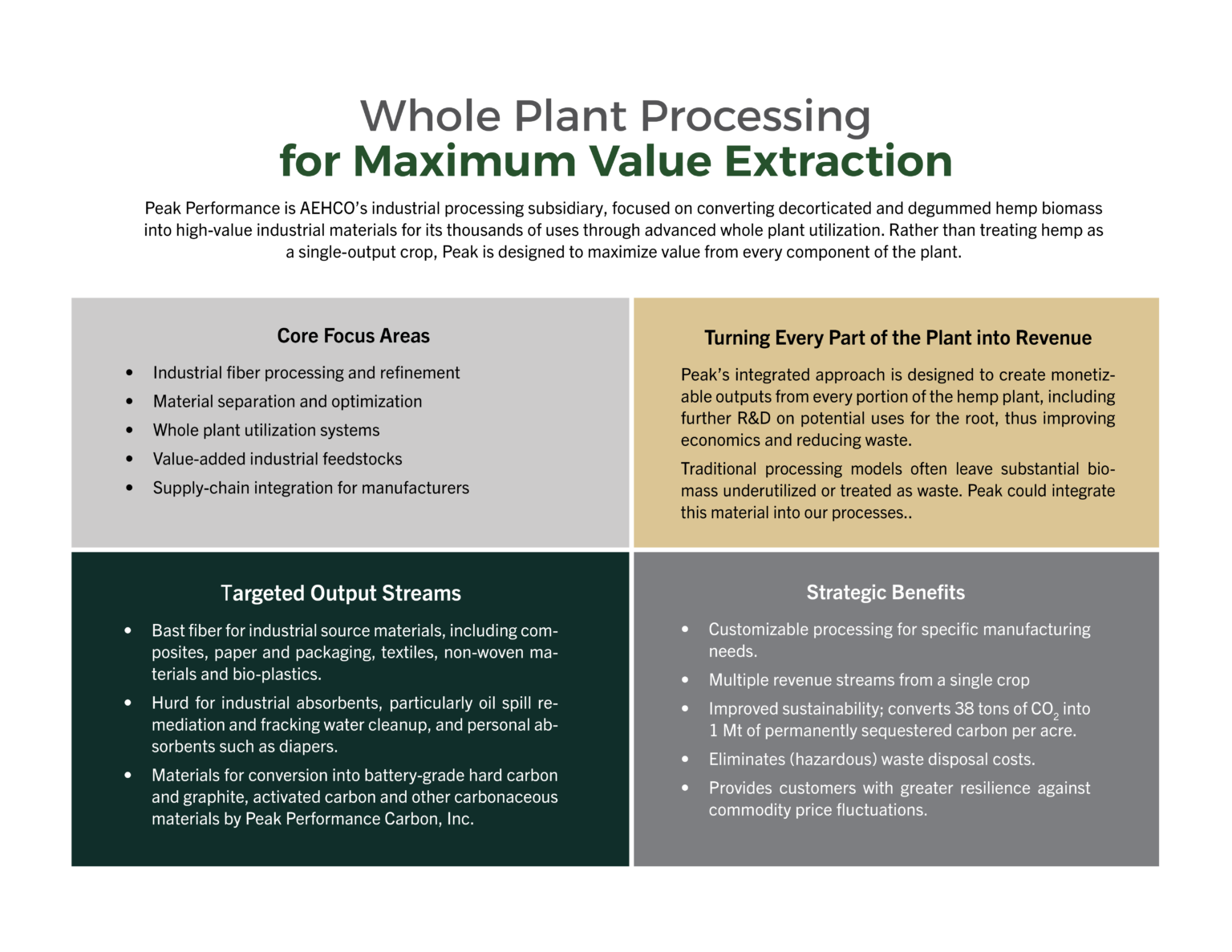
Not every application can work with fiber straight off the Kingsley-Walker line. When a customer’s end use calls for more extensive transformation — composite materials, nonwovens, bio-plastics, or absorbents — that fiber is routed to Peak Performance, where it’s processed further to fit the customer’s specific technical requirements.
In short: K-W supplies the raw, fiber-ready material and handles anything that stops at decortication and bio-retting. Peak Performance picks up from there for everything that needs to go further.
Peak processes hemp into customized source materials that manufacturers can incorporate into their own products, providing a renewable — and often on par or superior performing — alternative to conventional petroleum- and synthetic-based materials.
Nonwoven Materials
Hemp nonwovens are used in insulation, filtration, automotive components and construction. The fiber’s natural structure delivers strong sound absorption, vibration damping and lightweight performance — a sustainable alternative to synthetic and mineral-based nonwovens.
Bioplastics
Hemp fiber enhances the mechanical performance of molded and 3-D printed components, including improved rigidity and impact resistance. It also improves their environmental profile, reducing reliance on petroleum-derived resins and supporting more circular, bio-based supply chains across packaging and consumer goods.
Cardboard Packaging
Hemp provides a renewable, fast-growing source of pulp for strong, lightweight, recyclable packaging materials. Compared to traditional wood-pulp cardboard, hemp offers greater tensile strength and durability while requiring fewer chemical inputs during processing, positioning it as a scalable alternative for sustainable packaging.
Composite Materials
Hemp provides a renewable, fast-growing source of pulp for strong, lightweight, recyclable packaging materials. Compared to traditional wood-pulp cardboard, hemp offers greater tensile strength and durability while requiring fewer chemical inputs during processing, positioning it as a scalable alternative for sustainable packaging.